Actually, Japan has changed a lot
Actually, Japan has changed a lot
The 2020s are not the 1990s.
Reading the widely discussed farewell essay by the BBC’s outgoing Tokyo correspondent, Rupert Wingfield-Hayes, I felt a deep sense of frustration. The veteran journalist summed up his impression of Japan — where he has lived and worked since 2012 — as one of stagnation and stasis, declaring that “after a decade here I have got used to the way Japan is and come to accept the fact that it is not about to change.”
And yet as someone who has lived in Japan, and who has gone back there for about a month out of every year since 2011, and who has written fairly extensively about the country’s economy, I can tell you that it absolutely has changed, in important and highly visible ways.
But before I go through Wingfield-Hayes’ article and explain all the things I think it gets wrong, I should say that although I’ve never met him, he seems like a good guy who honestly wants to see Japan do better than it’s doing. And some of the criticisms he makes are both accurate and very important.
For example, I think he’s absolutely right to identify gerontocracy as Japan’s fundamental problem. Wingfield-Hayes points to political gerontocracy — elderly voters maintaining the power of an elderly, ossified political class — but I think an equally or even more important problem is corporate gerontocracy. The near-universal practice of seniority-based promotion, combined with low startup rates and population aging, has led to an ossified class of corporate executives and managers who would rather preside comfortably over declining little empires than embrace new technologies and business models and take new risks. That in turn has caused Japanese companies to fall behind foreign rivals as they miss technological revolution after revolution — microprocessors, smartphones, semiconductor foundries, battery-powered cars, etc.
Wingfield-Hayes is also right to decry the low-productivity menial jobs that Japan has in abundance. Hiring 6 people to do the job of 2 is sadly common in Japan, and it’s a big reason why Japanese people earn such low and stagnant wages. The heart of the problem is the lack of new high-growth companies, which is due to deficiencies in R&D, lack of late-stage startup funding, and (especially) Japanese companies’ failure to tap export markets in lieu of their shrinking home market.
So Wingfield-Hayes is right to see Japan as a country that used to embrace the future and no longer does, and he’s right to point the finger at gerontocracy as the key problem. But his broader characterization of Japan as a stagnant, static society is very much off the mark. And I worry that this kind of article leads Western readers to think about Japan in terms of the cliches of the 1980s and 1990s — the postwar manufacturing successes, the bubble economy, the lost decade, etc., all of which Wingfield-Hayes repeatedly mentions. Those events were certainly important, but they don’t really define modern Japan or the challenges it faces in the 2020s.
Anyway, now let’s talk about some of the big recent changes in Japan that I think Wingfield-Hayes failed to appreciate.
Japan builds and builds and builds
The BBC correspondent’s most baffling argument is — if I read him right — that the built environment of Japanese cities has stagnated. This would be very strange indeed for a country that famously tears down its buildings after 30 years. Every time I go to Japan, I’m stunned at how many new buildings there are.
Wingfield-Hayes’ waxes nostalgic about the urban landscape of early 1990s Japan:
When I arrived in Japan for the first time in 1993…[what struck me was] how exquisitely clean and orderly Tokyo was…Tokyo was a concrete jungle, but it was a beautifully manicured one…In front of the Imperial Palace in Tokyo, the skyline was dominated by the glass towers of the country's corporate titans - Mitsubishi, Mitsui, Hitachi, Sony.
This was true enough, but in fact Tokyo is much more like this now than it was in 1993. The city is actually much more beautifully manicured than when I first saw it two decades ago. Grungy “shitamachi” areas have been modernized, many dowdy old “Showa” style apartment buildings have been replaced with modern construction, sculptures and decorations have been added everywhere.
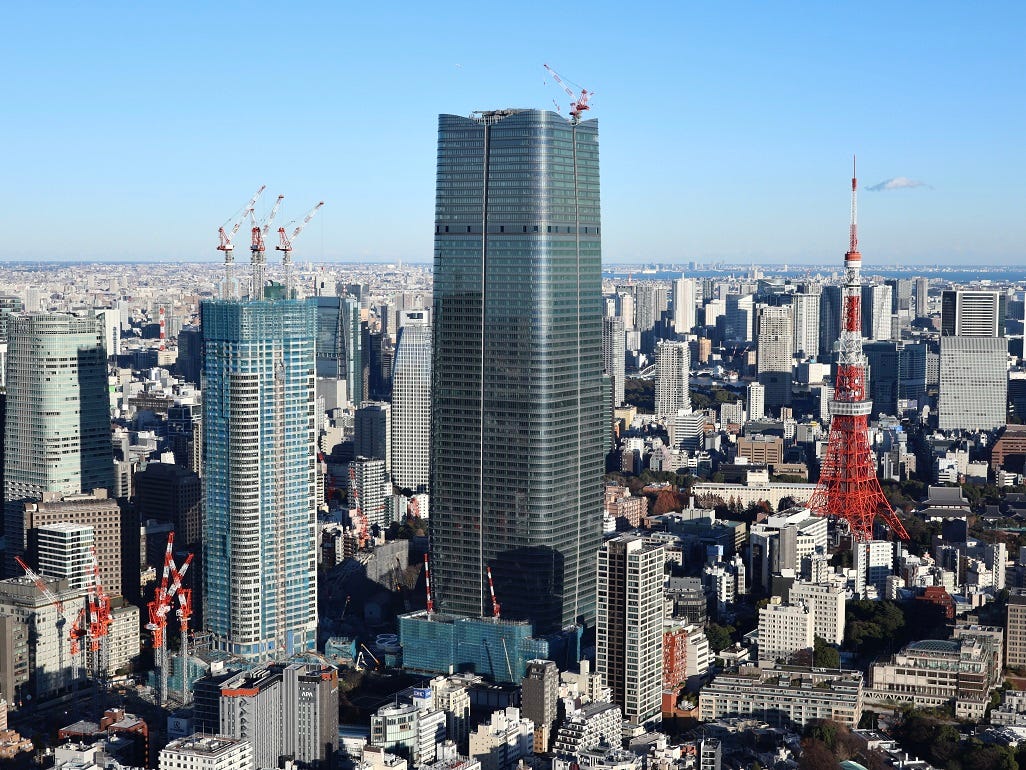
Meanwhile, the glittering signs and soaring towers that we associate with urban Japan have only multiplied. If you’re impressed by big buildings, for example, it’s impossible to miss the vast, towering structures that the Mori Building Company is putting up all over the city. The biggest one, shown in the photo at the top of this post, is due to open this year. But it’s not just big towers getting built. Shopping centers, bars, clubs, and glittering zakkyo buildings (the ones with all the signs) continue to multiply. How could you live in Tokyo for a decade and miss all that?
In fact, Japan’s fervor for constant scrap-and-build construction is a major reason why rent there is so affordable, and why local politics haven’t halted dense development as they have in the West. Wingfield-Hayes opens his article by complaining that Japanese houses tend to depreciate instead of appreciate:
In Japan, houses are like cars.
As soon as you move in, your new home is worth less than what you paid for it and after you've finished paying off your mortgage in 40 years, it is worth almost nothing.
It bewildered me when I first moved here as a correspondent for the BBC - 10 years on, as I prepared to leave, it was still the same.
Weirdly, this is presented as a chronic problem — something Japan should have fixed long ago, but hasn’t. But in reality, depreciating real estate is one of Japan’s biggest strengths. Because Japanese people don’t use their houses as their nest eggs, as they do in much of the West, there is not nearly as much NIMBYism in Japan — people don’t fight tooth and nail to prevent any local development that they worry might reduce their property values, because their property values are going to zero anyway.
As a result, Japanese cities like Tokyo have managed to build enough housing to make housing costs fall, even as people continued to stream from the countryside into the city. If you think Japan is stagnant, consider this comparison between Tokyo and some leading Western cities:
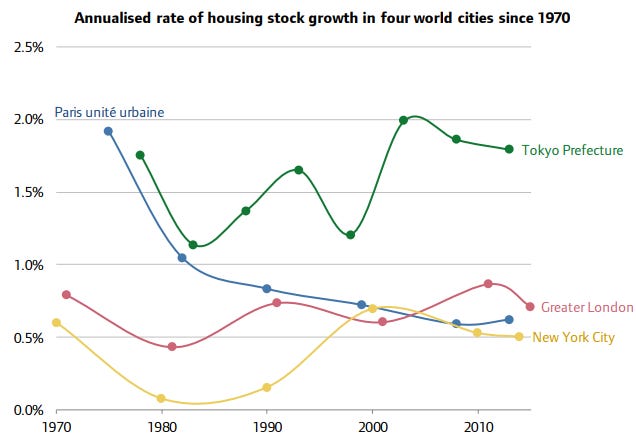
Even more amazingly, Japan managed all of this while increasing the size of the average person’s home:
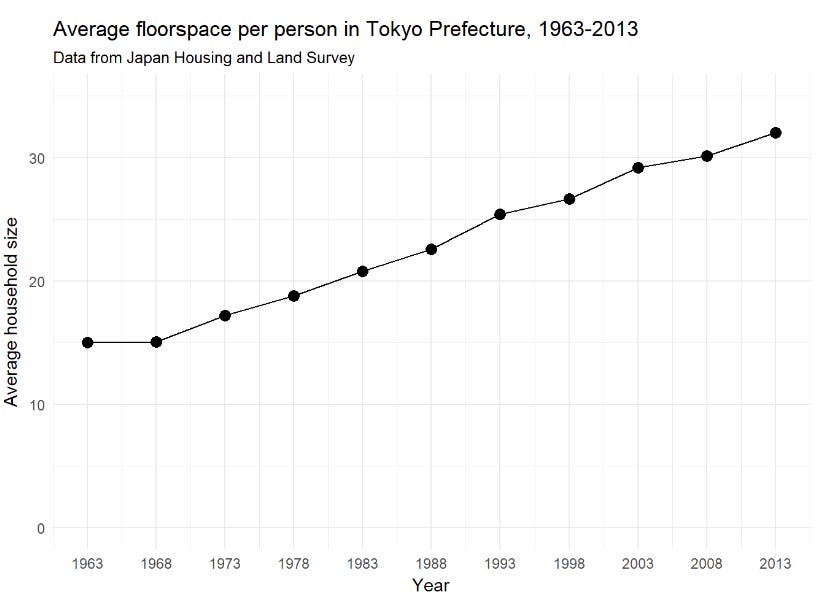
In the bubble era that Wingfield-Hayes pines for, Japanese urban apartments were widely derided as “rabbit hutches”, but four decades later their floor space per person is similar to European standards and higher than in the UK.
Why does Wingfield-Hayes think depreciating housing is a problem? Perhaps he believes this means the Japanese middle class is unable to build wealth. But when property tends to depreciate, it means that houses don’t cost as much to buy in the first place; that lower price frees up household cash that can be put into stocks and bonds.
Basing wealth on productive assets instead of unproductive land is good for the economy — housing scarcity might pump up prices and build individual wealth for homeowners, but at the national level it simply holds back economic growth. And as it turns out, it’s good for middle-class wealth as well — in 2022, Japan’s median wealth per adult was about $120,000, compared to around $93,000 in the U.S. (And this is despite the fact that Japan’s once-legendary household savings rate has collapsed!)
So Japan’s somewhat unusual choice not to tie middle-class wealth to housing prices seems like a smart one. Over the past two decades, the country has done better in terms of housing policy, construction, landscaping and urbanism than just about any country in the West. And it did this by embracing constant change rather than the physical stagnation that has prevailed in Western cities.
Babies, immigrants, and women in management: more than you think
Wingfield-Hayes, like many others, dings Japan for its low birth rate:
A third of Japanese people are over 60, making Japan home to the oldest population in the world, after tiny Monaco. It is recording fewer births than ever before.
As I wrote in a post earlier this week, aging is a real problem. But it’s a problem that every developed country is dealing with. What few people seem to know is that Japan’s fertility rate is actually higher than any of the other countries in its region:


As Bloomberg’s Gearoid Ready has noted, the only reason we associate the low fertility trend with Japan is that it started there first.
The BBC correspondent also claims that Japan has not embraced immigration as a solution to its aging problem:
[Japan’s] hostility to immigration has not wavered. Only about 3% of Japan's population is foreign-born, compared to 15% in the UK…If you want to see what happens to a country that rejects immigration as a solution to falling fertility, Japan is a good place to start.
This would have been a very fair characterization in the 1990s or the 2000s. But during Wingfield-Hayes’ decade in the country, Japan’s immigration policy changed substantially, and he ought to have noticed. Here’s a Bloomberg article I wrote in 2019 about the changes implemented by the late Prime Minister Abe Shinzo:
In recent years, the Abe administration has adopted major changes that will probably sustain the influx of immigrants. In 2017 Japan implemented fast-track permanent residency for skilled workers. In 2018 it passed a law that will greatly expand the number of blue-collar work visas, and -- crucially -- provide these workers with a path to permanent residency if they want it.
These changes thus represent true immigration, as opposed to temporary guest-worker policies (despite the common use of the term “guest worker law” to describe the new visas). In time, it will mean a more ethnically diverse Japanese citizenry. Permanent residents are allowed to apply for Japanese citizenship after five years.
The BBC even reported on some of these changes when they happened.
As a result of these policies and some others, the number of foreign-born workers in Japan doubled in the first few years Abe was in power.
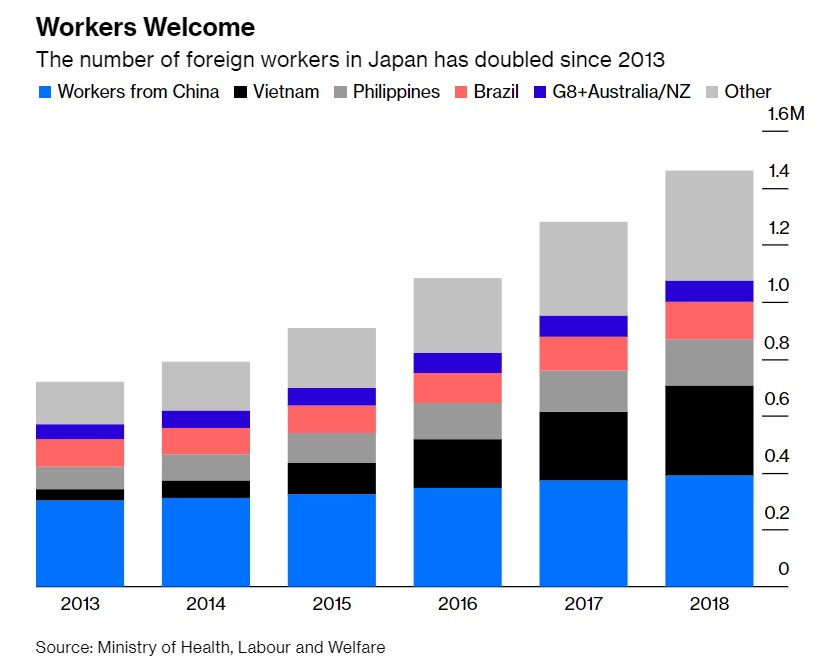
The 3% number that Wingfield-Hayes cites represents a dramatic increase over the 1% of just a few years earlier. Tokyo itself is an international city now; in 2018, 1 out of 8 people turning 20 in the city proper wasn’t born in the country.
Yet another example is the role of women in the workforce. Wingfield-Hayes rightfully dings Japan for not having enough women in corporate management, but neglects to mention that the percentage increased from 11% to 15% during his time there — not a massive social transformation, but not a picture of stasis either.
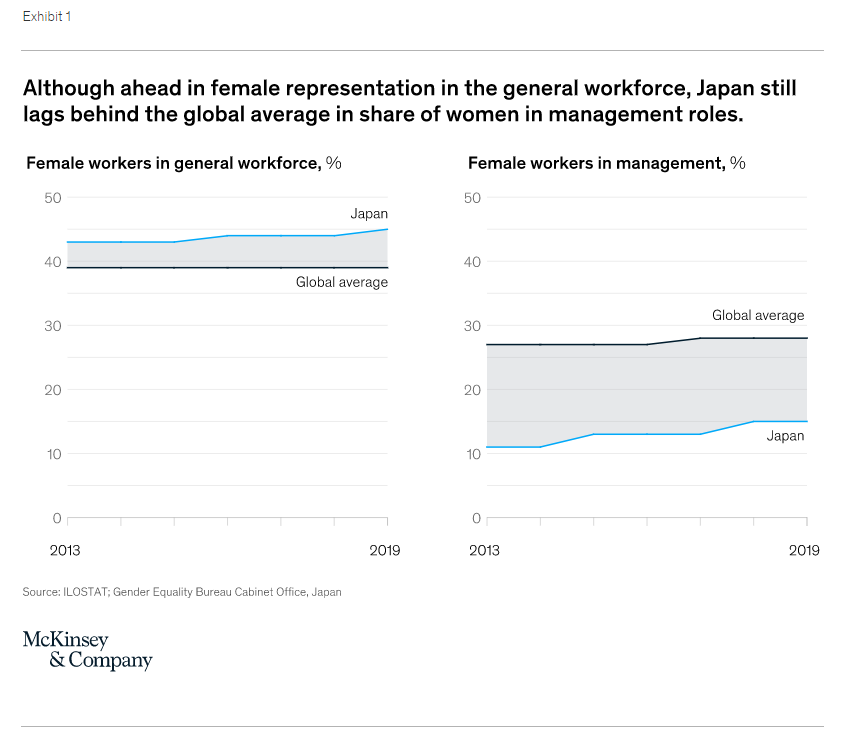
And this was accompanied by a large-scale movement of women into the workforce, such that Japan’s female employment rate now exceeds America’s.
Out with the old cliches
In other words, although Wingfield-Hayes lived in Japan during the 2010s, his assessment of the country seems very much stuck in the 1990s. Despite the fact that (by his own admission) he does not speak much Japanese, he really ought to have noticed the big changes that were happening all around him.
Anyway, perhaps you’re asking: Why does any of this matter? I admit that part of my determination to rebut charges of Japanese stasis is just personal pique — irritation at the cliched cultural essentialism that still defines Japan in the minds of too many Westerners. I suppose thinking of Japan in terms of the bubble and crash of the 80s is less ridiculous than thinking of it in terms of samurai traditions and The Chrysanthemum and The Sword. But still. Come on.
Perhaps, though, there actually might be a little bit at stake here. As Japan becomes a more open, globalized country, Western ideas and opinions have the potential to change Japan for the better. Outside perspectives could help Japan to solve the very real problems of the 2020s — corporate ossification, technological slowness, etc. But if Westerners essentialize Japan — if they think of it as a country and culture frozen in amber — they won’t have much to offer the country in the here and now. Japan is, in fact, a very dynamic and changeable place.


I don't understand how you can be a correspondent somewhere without learning the language, it's like trying to be a sports commentator with a blindfold on. Yes I'm sure you can manage it with other people's help but surely you'd prefer someone who can see the field?
Plus, he's married to a local and has three half-Japanese kids. And yet Rupert still think the sun never sets on the British empire. Oh, blimey!
I think this is kind of a misapprehension about what the role requires. The job requirement and skillset of a foreign correspondent is to know the journalistic trade and churn out reliable copy, not be a linguist. The guy who's talented at researching and writing stories within the brief but can't speak the local language will beat someone who speaks the language but is an average writer 10 times out of 10. Reading his bio, Wingfield-Hayes moved from being the BBC correspondent in Beijing, Moscow and Jerusalem. Clearly his bosses think he is good *at being a foreign correspondent* whether or not he can speak Hebrew, Russian or Chinese (although his wiki also says he studied Chinese in Taiwan, so). Given that context, and moving to Toyko in his mid-40s, it's understandable why he may not have picked up Japanese.
At any rate, the critique of Noah's article doesn't seem to be that he's missing the sort of qualitative cultural knowledge one would get from speaking Japanese with locals, but that he is unaware of quantitative statistics on immigration, house building etc. and structural changes in the Japanese economy over the past decade. It's difficult for me to tell whether the value added here would be in learning the Japanese language, rather than say reading more about Abenomics in English.
I understand that it is not a necessity for his job but do think it is odd that he lived a decade there and never attempted to learn the language. I would think that if I lived abroad for an extended period of time that I would at least try to learn the language on a basic level.
They say this, but I don't fully buy it. I lived in the Middle East for ages and knew lots of foreign correspondents that never bothered to learn Arabic, and they were always limited in what they could do. They learned about stories mostly from people who interacted with the expat community and often lacked real context for what they were seeing. They all had the same line about the process but I think they just couldn't be bothered.
Now if you're looking to sell newspapers, maybe that's all you need - I'm sure he's an expert in the style the BBC editors will put on the front page. Well-educated, English-speaking locals are way more likely to give you a narrative that sells well at home than a random villager. The BBC article certainly seems to have done well. But to actually understand and explain a country? I think you need to understand the culture, and that includes the language.
Yep, I immediately discounted his expertise at that point. Why does he even need to be in Japan if he isn’t getting any knowledge from being there?
That was very odd to me. Especially if you lived there for a decade but you never made an effort to even have a basic grasp of the language
He's just British, that's all.
Apparently the Beeb couldn't find any fluently English-Japanese bilingual people who can write well.
/s
"I admit that part of my determination to rebut charges of Japanese stasis is just personal pique — irritation at the cliched cultural essentialism that still defines Japan in the minds of too many Westerners."
As a person who spent the entirety of my career living in other countries on three continents, I deeply relate to this pique. Which isn't just reserved for the non-Western countries, btw: I have lived in Sweden for five years now. What other European country (besides maybe the UK and France) lives rent-free in the minds of American commentators, as an ever-useful foil for anything you wish to celebrate or criticize at home! The COVID period has been a whipsaw of Sweden essentialism, ironically swinging from stereotypes of Nanny State Socialism to Free Capitalist Individualism. As with Japan, fans and critics alike are basing their impressions on (then equally stereotypical) views of the country from a generation ago. And even when those commentators have more direct experience from traveling to or living here, it's bizarre how much that second-hand first impression overshadows the reality before your lying eyes! Sweden must continue to exist as a contingent entity for the purposes of Anglophere argumentation.
Is this a limitation in the medium of essay-writing and dispatches, which forces the author to give pithy takeaways and to collapse complex societies into simple parables? Even saying things like "Japan is good/bad at X" is fraught with ontological and epistemological peril, since to form that narrative we're generally universalizing an anecdote or some striking data to be representative to the experience of a population of 125 million people with significant variance among sub-samples and places. But then what's the alternative? Writing some drab, over-qualified paragraphs where the takeaway is "Well, it depends..."?
TBF, the US thinks of itself largely in terms of the mid-20th century, notably in the idea that the US is a generous donor of foreign aid, something that was only true in the years of the Marshall Plan. And the UK is stuck in about 1940.
Australia isn't immune: our current PM is nostalgic for the "Australia that made things", which has been gone for a long time.
I don't think the U.S. thinks of ourselves that way...I think we think we're still in 1868
We are trying to oscillate within a four year band centered around 1875
"microprocessors, smartphones, semiconductor foundries, battery-powered cars" is an interesting list - in phones they famously charted their own path but had some technologies (phone payments springs to mind) far earlier than in the west; the Prius was the first major hybrid; and I think semiconductors is a complex story to say the least.
But more widely, Japan has changed a lot over the last ~20 years. Tokyo is unrecognisable (and unnavigatable). Rural depopulation has gone from something worried about, to a crisis, to some signs of experimental alternatives. And to me the country as a whole feels much more international and internationally connected than ever.
One question: my memory is that my old economics tutor argued that Japan's growth rate on a per-working person basis was actually fine. Is that right?
Yep. Did you see my post about aging, the other day? I talked about this a bit:
https://noahpinion.substack.com/p/how-much-does-aging-really-hurt-a
Your "unnavitagable" bit is spot on. Sheesh. Shibuya and Shinjuku are disasters. My spacial processing is good enough that I can deal with Shinjuku by carefully remembering how it used to be and using that to get to where I want to go, but my SO just memorizes specific routes to where she needs to go and only uses those. (The new geometry is actually better: there's now a cross-station walkway that's central and outsde the JR system.) I go through Shibuya once a month, and it's different every month. This has been goin on for the last several years, and they're still mucking with it. Oh, yes, the JR Ochanomizu station is a never ending mess also.
Many respected economist like Krugman and Dean do make that argument. And while there is some truth to it they overstate a lot
This piece is a great example of why I love your Substack. I would never think to read up on the finer points of Japanese housing and economic trends. Appreciate you bringing us an eclectic mix of subjects to read and learn about.
As someone who lived in Japan from 2017-2022, I think the truth lies somewhere between Rupert Wingfield-Hayes and Noah Smith. Noah seems more than picqued, down right irritated with the BBC article and he throws a veritable barrage of statistics to show that Wingfield-Hayes was wrong. Both articles contribute to the truth.
I think that the economic statistics by themselves as provided by Noah do not reflect the nuance of Japan, for example female participation is usually in part time and lower salaried jobs, not those of the professions. The landscaping which he mentions as something Japan is successful at, is a matter of conjecture. With the exception of one major river, all the rivers in Japan have had concrete modifications at some point, likewise, there are a handful of natural beaches that do not have concrete in place somewhere, whether the infamous tetrapods, or some harbour for a half a dozen fishing boats in the middle of nowhere. The reality is that much of this concrete is pork barrel politics by the LDP and worryingly they are running out of things to concrete. Nature however, is something to be feared in Japan and therefore shaped, even controlled (and an understandable fear given the earthquakes, typhoons, etc he country experiences), however I don't think Japan has any great claim to landscaping. If you were to say something about the landscaping it would be an incredible attention to detail, with pruning within a millimetre of a plants life, what you are left with though is nothing natural. Plants and trees are shaped, just as Japanese culture shapes the people.
Likewise the building code is regularly updated to take into account earthquake proofing of building, however this is arguably as much about supporting the building industry and drives the incessant demand for building. What Noah misses is that because houses do not retain value, because it is difficult to own land on which to build, investment in insulation, advanced building techniques is very low. Passivehaus is almost unknown. Why invest in insulation and new building techniques when you will probably knock the house down in 40-50 years, much easier to shove in more air con! Don't get me wrong, I think the West obsession with housing values is a disaster, but I don't think it is as simple as Noah put.
Likewise the saving rates in Japan are admirable, in part though because of the provision in retirement. However, companies often do not return value to investors, they hoard cash, vast mountains of it much to the annoyance of the Japanese Government. Most investments are in the Japanese Post Office paying almost zero percent interest but allowing the Japanese Government to run massive deficits year after year. So Noah is statistically right about investment, but arguably wrong about the outcomes.
As for immigration, I would agree it has developed, you can see it in the staff just on a high street, however Noah misses the point, that the 5 years immigration visa introduced particularly with South Asians in mind, is just that, come for 5 years and go home. There is a wider cultural issue with acceptance of immigration, something Wingfield-Hayes pointed out, in asking whether he could live in a village. At the moment it takes 10 years before you can apply for residency, far longer than say the UK. There is no green card lottery like in the US. Japan continues to struggle with immigration, even if statistically it is better. Both writers are correct. Japan knows it needs people, but fears dilution of Japan (which is ironic given how many traditions Japan has assimilated as its own - for evidence of that look at the food culture).
As for the baby issue, while Noah is again right (he's often right) about Japan not being as bad as Korea or China, I'm not sure what benefit that is. So all of East Asia faces a demographic bomb, but Japan's demographic bomb is marginally better than Korea, etc. There are some much more interesting statistics which raise worrying underlying cultural trends in Japan, such as the lack of interest in marriage, lack of sexual experiences in people under 40, preference for female companionship or playing video games. I'm not comparing with other countries, however, it is fascinating to see some of the social trends which seem resistant to what ever government throws at them. Wasn't it Peter Drucker who famously said: "Culture eats strategy for breakfast"? You could say culture eats statistics for breakfast as well - certainly in Japan culture is the over riding dominant factor and it is one which is endlessly fascinating and extremely difficult if you are a gaijin.
I thought both Rupert Wingfield-Hayes article and Noah's really interesting. I think both contribute to the debate, I enjoyed reading them. Both are also lessons in the perils of generalisations, and I'd end with - I think - a quote from Satre: "I dislike all generalisations, including this one".
Thank you for this post — which I want to re-read carefully. As someone with a ton of (admittedly Tokyo-centric) Japan experience — but all since 2010 — I found the framing and tone of RWH’s article disorienting to say the least. Fackler at the Times was often worse — he used to give the impression that he hadn’t enjoyed Japan since 1989…. Not that Japan doesn’t have a lot of issues!
On re-reading, one note I’d share is that more than one successful Japanese friend at top firms (trading houses, hi-tech) confessed to me that the most incandescently stressful moments of their careers have been when they had to manage someone older than themselves. Which is to say, there is a cultural element of the gerontocracy to be considered. It’s not just about clinging to power at the upper echelons…
I have a crazy idea about Japan, which seems completely counterintuitive. But here goes anyway. Feel free to explain to me politely why it can’t be right.
Basically, I think Japan is trying to avoid being noticed too much by the rest of the world. I read somewhere that when Japan first conquered Okinawa, they didn’t want anyone to know they’d done it. Once a year the representative of the Chinese Emperor would visit the island, and the Japanese occupiers would hide for the duration of his visit.
In western democracies we’re used to the idea that, if your country is doing well, your politicians have to tell everyone else how awesomely well you’re doing. And if you’re not doing well yet, you still have to be positive, and flaunt whatever success you have: fake it till you make it. When he was President, Donald Trump took this boastful attitude and ramped it up to 11. In the UK we think of Harold Macmillan’s “you’ve never had it so good”, or Tony Blair’s “Cool Britannia”. In the USA there was Ronald Reagan’s “Morning in America”. But I’ve often thought the opposite approach might be better. Maybe a country would benefit from seeking to portray its economy as worse than it actually is, its military weaker than it actually is, and so on.
Why would Japan want to do this? I suspect there are deleterious forms of foreign investment. Wealthy foreigners buying houses they don’t intend to live in probably make things worse for the locals. I suspect there are other forms of “feeding frenzy” type foreign investment which are harmful to a country. Didn’t Japan suffer from some of these in the 1980s? Maybe they’ve learned that lesson.
Koizumi had Cool Japan (and the NHK talk show with that same name where a panel of foreigners discuss Japan cultural issues is still on the air). I don’t think anyone in Japan especially leaders think they are an inferior country. And I don’t think foreigners buy much real estate there, although there are government programs to encourage foreigners to buy houses, start businesses/farms or even marry locals in the depopulating countryside.
I don’t think the Japanese think their country sucks. Sorry if I wasn’t clear about that. I think that they’ve learned that the wrong kind of foreign attention - especially financial attention - can be bad for the country. Otaku culture, or people thinking Anime or Babymetal is cool, that isn’t really what I’m talking about. These types of attention don’t distort the market fundamentals by much.
Japan’s 1980s asset price and stock price bubble was largely caused by foreign investors thinking Japan was the world’s miracle economy and they just had to have a part of it at any price. International corporations decided they had to open offices in Tokyo, and between 1985 and 1991, they pushed up commercial land prices by 300%. The Japanese stock market experienced a similar bubble, with foreign traders pushing up stock prices by 225% in the same period. Eventually everything crashed down to earth, and Japan had its “lost decade”.
The bubble popped decades ago, and Tokyo housing has been increasing, becoming larger and more modern and remains affordable. The only housing problem I hear of anymore is the large and growing number of vacant single family homes in rural areas as the population urbanizes.
I much more agree with Noah than with Rupert. Rupert is stuck in the past and seems to have missed how things have changed here. The anecdote on the land owner refusing to decrease the price is just an anecdote and it does not reflect land price evolution at all.
I am not sure what "terrifying bureaucracy" means but no examples are actually given. The 4 employees taking care of a car at a petrol station ignores reality: almost 40% of petrol stations are now self-service, in particular in large cities and the percentage increases every year.
The story with the small village in the Boso peninsula completely ignores the movement of people moving out of Tokyo which has taken pace over the years.
Most large companies are completely different from what they were 20 or even 10 years ago. Tokyo is a completely different city than it was 10 years ago. The pace of change is incredible. Too bad for the BBC that this was all missed by this correspondent.
The story about the safety briefing for driving is also eerily similar to my experiences of speed awareness courses in the UK. Yes you have to participate a bit, but the general vibe was pretty much the same.
In California I had to sit through a safety class to clear a speeding ticket, but at least the retired cop giving the class had some interesting stories like the guy that died in a rearender because he had left his bowling ball on the car’s rear window shelf. In Japan I had to take the safety class after failing the very strict motorcycle license test and the old “instructor “ just droned on and on while the room full of “students “ slept in their chairs for almost two hours.
I also like Rupert W-H, but on reflection, that might be his voice and familiarity.
He seems trustworthy.
There in lies the issue.
The BBC is stuffed full of polite, confident, people who like travelling and opining.
As I have come to realise, it doesnt mean that they know any truths...
Both articles treat housing costs as if the building is all there's to it. But housing costs also include land. In popular locations, the land costs as much or more than the building. Buildings depreciate fast in Japan, but land usually remains valuable (except when some economic or natural catastrophe strikes). Paying for the land is a significant investment in Japan too -- hard for the young to afford and a nest egg for the old.
I've lived in Japan since 1999, and the changes the country has gone through since then are quite staggering, especially in the last 5-10 years in terms of immigration. It's noticeable almost everywhere, except perhaps extremely rural areas.
Japan is indeed going through great changes, and when the old people who run both the gov't and business filter/die out, I think we'll see more change come at an even quicker rate. We are already starting to see strong signs of the unsustainable processes breaking down in front of our eyes, and companies, cities, governments, universities, etc. scrambling to adjust.
I'll probably have more to say on this later, but since you mentioned gerentocracy, my new word for the week last week was (drum roll):
KING OF ROUGAI.
Which refers to Aso Tarou, because of something stupid he said (essentially blaming women for the small number of kids they're having, which is insanely stupid because the economy is such that large numbers of people can't afford dating*, let alone getting married, and would be insane to have anywhere near the number of kids they actually want (the last I checked, raising kids was more expensive in Japan than in any other industrialized country).)
*: This is because of (a) the Koizumi policy of letting big companies hire part timers instead of regular employees (who would have had niceties like retirement policies and some amount of job security), and (b) the minium wage is something like US$6.00 per hour.
Oh, yes "rou" is "old age" and "gai" is "the harm therefrom". (And "king of" is in katakana.)
This OECD report says child care costs are high for single mothers but comparable to UK and USA for couples not in poverty. https://www.oecd.org/els/family/OECD-Is-Childcare-Affordable.pdf. It seems a lower birth rate is more due to the lower number of young people than with childcare costs, and as Noah pointed out the rate is the highest in East Asia.
Woke journalists are the most hypocritical in the world. They scourge Japan for accepting migrants from all corners and races of the world, but when on holiday, they prefer to visit safe and traditional Japan, where they experience hanami with teary eyes, clumsily clap at Shinto shrines and enjoy special foods.
I have no idea what you’re talking about. Any woke journalists that I’ve seen mention Japanese immigration have been in favor of it, more than the Japanese people tend to be.
I don't know what you don't understand. Of course woke globalist journalists support migration. Which has ruined London, Paris and Berlin and full Sweden. But the woke journalist also likes order and special traditions, food, safety and culture if he is a private citizen and not an activist doing his job. That's why almost all of them are fans of Japan, which they are otherwise trying to destroy bit by bit by their activities...
Pro tip: "Cities I don't like" is not synonymous with "cities that have been ruined."
> They scourge Japan for accepting migrants from all corners and races of the world
> Of course woke globalist journalists support migration
You’re saying that they both don’t like it when Japan accepts immigrants and they do like it when Japan accepts immigrants. What are you talking about?
Also, plenty of “woke” people travel to “ruined” places like London, Paris, Berlin, or apparently all of Sweden. As someone who actually has traveled to those places recently, they’re doing great and they’re great places to travel to, so I think you’re just talking out of your ass.
I can't put it any simpler than this: woke journalists love migration, but don't like its consequences. so they are hypocrites...
Just a thought on London from Cleese:
https://www.youtube.com/watch?v=FyZ7Q-ruVpo&ab_channel=OmerGendler
But you must know the city better...
Then I think you made an error in your original comment.
You wrote "They scourge Japan for accepting migrants from all corners and races of the world"
I think you meant to write "They scourge Japan for NOT accepting migrants from all corners and races of the world
Thanks, I missed it with my Hungarian tought.
I was once invited to a dinner in Jeddah hosted by a Saudi prince in honour of a Japanese business delegation.
After the dinner the Japanese leader of the delegation rose to thank our host. He addressed him as "Your Loyal Highness"!
Great piece, iconoclastic. I learned a lot about Japanese housing and household money management, as well as the improving ethnic diversity. In re the BBC correspondent: it’s hard to read the label when you’re inside the bottle.
Note: the graph of floor space per occupant is in square meters, according to the link to statista
I really recommend reading the BBC article before or after reading Noah's piece. It's genuinely interesting. The things that irked Noah may well irk you but the writing really feels personal. The viewpoint of R W-H comes across strongly (and not to fall into essentialising my own culture but its wonderfully British).
On a side note Rupert Wingfield-Hayes is a perfect name for a BBC or Times foreign correspondent. Very Jeeves and Wooster. I hope he writes a companion piece on his view of Britain and how it has changed on his return. It might be that he will realise that Japan is stuck in a way that many places are and not for essentially Japanese reasons.
If Japan was a transhumanist society, they would also be trying to make their old people young again. But that kind of futurism is even rarer there, than in the west.
A lot of people don't update their knowledge about much of anything. Many Americans probably haven't heard anything since their old 90's based info, and have just stuck with it. A little more surprising for the place you live, though.
I guess he didn't start his career in Japan - like what he mentioned, he started his career learning Chinese. I also remember reading articles from him about experience stuck in North Korea. Maybe a question for BBC why relocating him to Japan
I always read what was written for a different culture or profession (anglosphere and economists). With very rare exceptions - Noah being one - texts are published only if they are consumable by the intended public. Articles (and almost all books!) are about finding an audience, not about explaining the world - writer almost always needs to make money with his writing, so he needs a paying audience. Now go and call me cynical :-)
Even if BBC (or Economist, or Financial times, or NYT) correspondent lived in [___x___] for 30 years and spoke fluent [__x___], he must repeatedly write what his public wants to read about x, or he will not be a correspondent.
A british thinker not disgusted by depreciating house values - they'd strip him of his citizenship :-) Almost like a US columnist claiming soldiers are exploited fools risking lives for elites to enjoy cheaper natural resources and advantageous international trade. Blasphemy. Sacrilege.
That is why I love Noah. He often writes stuff I don't want to hear. Chapeau!
Very interesting piece. You note that one of the key strategies used to bolster economic growth in Japan is an expansion of immigration and foreign workers. As the fertility rates in numerous countries around the world fall below replacement, will the world struggle to maintain positive gdp and market growth? How much of the growth from the last several decades/centuries has been driven by rapid population expansion?
Thank you for this, it's been easy to fall into the trap of seeing Japan as forever set in its ways. Would love to hear more about your time and impressions of Japan, where do you go when you go for a month each year? Can you speak Japanese?
Yet let's not forget the staggering deficit, they are pioneers in MMT. With a gerontocracy that will never get paid down and ultimately has to weigh down the country.
Question: What is it about housing in Japan that causes it to depreciate at a rate so much faster than in other countries?
They tear it down after 30 years.
And construction practices take this into account. In rural areas houses appear to be either newer than 30 years or over a hundred years old. When I was looking to buy a house there in the late 1990s all the realtors assumed that any house I looked at no matter how old would be demolished and replaced with new construction. They even quoted the demolition price (often quite reasonable) when negotiating.
I'm struggling a little bit with how one would design a house such that reconstruction rather than renovation would make economic sense after 30 years (but I know next to nothing about the building or construction trades so this is probably just run of the mill ignorance on my part). In particular, while large appliances (heaters, washing machines, etc.) are going to have lifetimes generally measured in decades, and roofs are usually a 20-30 year wear item here in the U.S., my impression is that there's nothing particularly special about U.S.-based wood-frame building construction or modern siding, and yet over here especially the frame is often closer to a 100-year+ lifetime even it it's essentially a series of commodity 2x4s. [1]
Is the idea that the parts that last the longest are also very cheap to reconstruct so why bother preserving them? (e.g. IDK how much of a house price framing is), or is it more that if you really want to penny pinch you can take members that have a 100+ year design-life in the U.S. and make them marginally cheaper by limiting it to a 30-year design life in Japan, and buyers don't care because the other upgrades attendant to a rebuild -- say, wiring and piping -- have to be done sooner or later in any case and it's probably cheaper on net to do it all in one shot rather than piecemeal (or, if not as cheap, as least everything is brand-new, although for my part I'd be concerned about bathtub-curve problems cropping up, but that may be less of an issue in Japan).
[1] Any factual mistakes here are mine and mine alone.
Many newer single frame houses in Japan are prefabricated in factories with minimal assembly on site. At least in the 1990s when I was looking for houses insulation and central heat and AC were rare. Older houses and shrines use traditional daiku construction with interlocking wood joints and no nails and last for a long time, but even ancient temples and shrines are rebuilt every few decades. I assume that if you want to renovate a house it can be done. There was a Japanese TV series called Before/After about house renovations which was interesting to watch but seemed popular since renovations are uncommon. This used to be available on TV Japan in the US here’s one episode on YouTube:
https://youtu.be/ydT6-0I5YC0
This article also discusses house renovation vs rebuilding.
https://www.theguardian.com/cities/2017/nov/16/japan-reusable-housing-revolution
This is changing quickly though and building standards are on the the rise. There are many new incentive schemes and tax deductions for energy efficient houses built to last for longer. Taxable depreciation doesn't always reflect market value either as we found it to be about the same price to build new compared to buying a ten year old house in our neighbourhood.
Sorry to belabor the question, but does it have anything to do with quality of construction and does this practice include apartment buildings?
One phenomenon I've noticed is that the quality of construction has been increasing with time since WWII. Japan rebuilt frantically after WWII, and much of that was of iffy quality. But building standards went up with time (and the improving economy), so the _age_ of a building isn't a measure so much of how much time has passed, but of the quality of the construction being done at the time the building was actually built.
Now there's a major problem with reinforced concrete condo buildings in the built 40 to 60 years ago class needing to be rebuilt, or at least renovated, and many of the condo owners are retiring in place folks who don't have the money to afford rebuilding, or even moving.
What drives much of the re-construction is new building codes to reflect lessons from earthquakes.
That applies to multi family housing but not really single frame housing which is generally assumed to have a fixed lifespan.
My experience is that housing age has a much more significant effect on price in Japan than, say, NY. For all kinds of preference/status reasons and safety reasons, and financial incentive reasons. There is no status that I ever noted being conferred in the Tokyo equivalent of a 19th century Brooklyn Heights mews house, except maybe in Kagurazaka or something…
The newer buildings are meant to be much safer — and the quality of all the amenities in them seem higher — so I suppose quality is part of it. For obvious reasons, there is no equivalent to, like, the Dakota or San Remo in Tokyo…
Most housing/buildings may not hold much value, but the property itself retains value (at least in non-rural areas). But you can buy beautiful houses/property in the country in Japan for a song.