日本人の賃金が停滞し続ける「日本特有」の理由 / Why Wages Slowed In Japan More Than Elsewhere
Why Wages Slowed In Japan More Than Elsewhere
ここ数十年、実質賃金が上がっていない富裕国は日本だけではない。しかし、豊かな国の中で賃金の上昇率だけではなく、賃金自体が下がっているのは日本だけである。
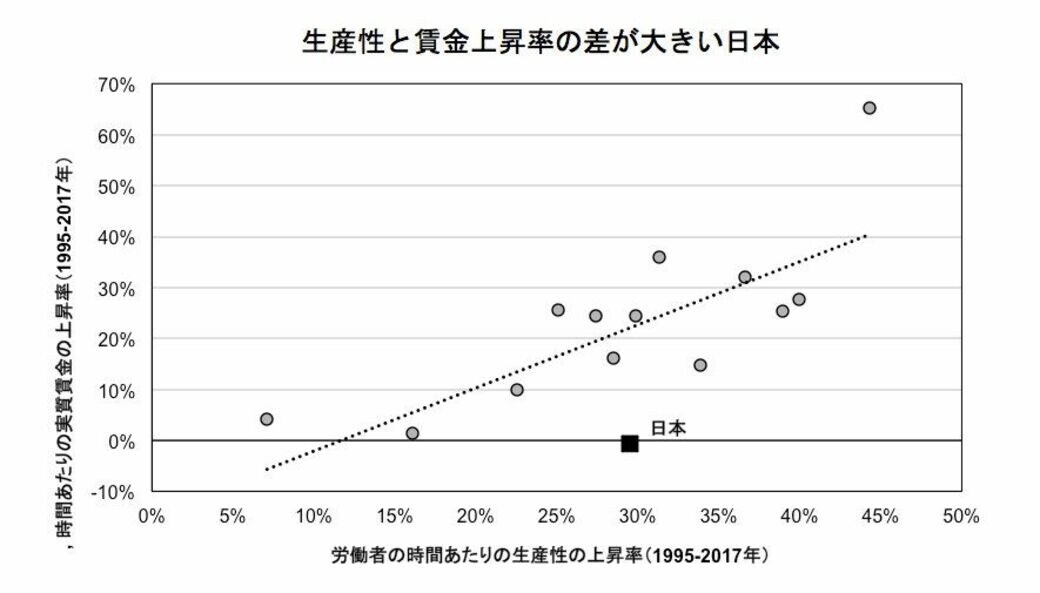
成熟国では、賃金は、100年以上GDPとほぼ同じ割合での成長をしていたが、その傾向も最近はなくなってきている。1995年から2017年の間に、生産性、すなわち労働時間あたりのGDPは豊かな11カ国で30%成長した。しかし、実質的な時間当たりの報酬(賃金+福利厚生)は、その半分の16%しか伸びていない。
日本の状況は「衝撃的」
日本の生産性の伸びは30%と、他国と同じだったが、労働者の賃金は1%減少している。日本の労働者の賃金が最近まで他国の労働者のそれよりも国民所得に占める割合が高かったことを考えると、この状況は特に衝撃的だと言える。
このような賃金上昇率の低迷は、歴史的にも経済理論的にも説明がつかない。何十年もの間、経済の教科書には、市場経済が長期的に安定するためには、消費者の需要、ひいては賃金が生産高と同じペースで成長しなければならないと書かれてきた。その結果、1800年代以降、国民所得のうち、資本家ではなく労働者に分配される割合(利益、利子、家賃、配当金などの形で)は、ほぼ一定の水準で推移してきた。しかし、数十年前になぜか状況が変わった。
「先進国では、労働所得のシェアは1980年代から低下傾向にあり、過去半世紀で最も低い水準に達した」とIMFは2017年に報告している。OECDによると、1990年から2009年にかけて、富裕国30カ国のうち26カ国で労働分配率が低下しており、平均的には66.1%から61.7%に低下したという。
その1つの結果として、財政赤字が増え続けている。賃金が抑制されると消費者の需要が減退するため、ほとんどの豊かな国では、税収以上に多くの支出をして総需要の不足分を補わなければならない。
これはなぜなのか。経済学者の中には、第1の原因は技術的なもの、つまり情報通信技術(ICT)の台頭だと主張する者もいる。また、労働者の交渉力が弱まっているとの意見もある。ほとんどの豊かな国では、これらの要素が混在していると思われるが、日本の結果は非常に特異であり、政治的なパワーバランスがより大きな役割を果たしていると考えられる。1つずつ説明していこう。
多くの経済学者は、ICTは過去の技術と何かが違うと考えている。具体的には、これまでの技術と比べて、ICTは労働力、特に労働経験がない、あるいは経験が浅い労働力の需要減少を招いた一方、高いスキルを有する労働力への需要の増加につながった。結果、経済成長の成果が資本の所有者の手により多く渡ることになった。
低・中技能労働者が「犠牲」になっている
IMFによると、「世界の労働分配率の低下は、低・中技能労働者の負担となっている。1995年から2009年の間に、低・中技能労働者の合計労働所得シェアは(GDPの)7%ポイント以上減少したが、世界の高技能労働者のシェアは5%以上増加した」。
IMFは、国民所得に占める労働分配率の低下の半分は、新しいテクノロジーが原因と推定している。これはグローバリゼーションによって多少増幅されるが、その影響はポピュリストの政治家が主張するほど大きくはない。OECDは、労働分配率低下の原因の8割は、テクノロジーとその関連事項であると推定している。この見解だと、テクノロジーの発展は避けられないため、この傾向を是正するためにできることはほとんどない。
ここで気になるのは、これが恒久的な変化なのか、いずれは自己修正される一時的な変動なのか、である。
自己修正は、1830年代に「ラッダイト」と呼ばれる労働者たちが綿花工場の機械を破壊して以来、省力化技術の結果として行われてきた。技術によって一部の仕事が失われても、生産性の向上によって得られる収入の増加は、より高い教育を必要とする新しい仕事への需要を生み出す。その結果、労働者はより高い賃金を得ることができる。
長期的に見れば、ICTはこれまでの技術と変わらないのではないだろうか。 OECDは、労働分配率の低下が 「ICTベースのテクノロジーの普及プロセスが鈍化によって徐々になくなる」かどうかを判断するには、まだ十分なデータがないとしている。時間がその答えを出すだろう。
ICTは重要だが、それだけでは説明できない。なぜなら、賃金抑制が始まったのは1970年代後半から1980年代前半であり、パソコンとインターネットの融合によってICT革命が起こる20年前のことだ。また、同じ技術を使っているのになぜ、豊かな国でこれほど賃金と生産性の格差があるのだろか。
労働者の交渉力の低下が賃金低迷に影響していると指摘する専門家もいる。後にIMFのチーフエコノミストとなるオリビエ・ブランチャード氏は2001年にはすでに、賃金シェアの低下は、労働組合の弱体化、新自由主義的な規制緩和策、労働者と政党の過去の提携関係の弱体化に起因すると主張していた。
典型的なOECD諸国では、組合員は1970年代後半にピークに達し、全労働力の半分を占めていた。それ以降、組合員数は減少の一途をたどり、今ではわずか20%になっている。日本では、1960〜1975年には労働者の3分の1が組合に加入していたが、現在は17%にとどまっている。
同時に、反トラスト法が弱体化したことで、一部の"スーパースター企業"が、多くの主要産業で圧倒的なシェアを獲得し、企業の消費者、そして従業員の双方に対する交渉力が強まった。結果、こうした産業における労働分配率の低下は一層深刻になった。
国の賃金の命運を左右するのは「政治」
テクノロジーだけでなく、政治的な影響もある。すなわち、国ごとの賃金の運命は、その国の政策立案者や政治に大きく左右されるのだ。
賃金の伸びが生産性の伸びを上回った4カ国のうち3カ国は、労働者の政治力が強い北欧3カ国だった。一方、国民所得に占める労働分配率が最も低下した4カ国のうち3カ国は、労働協約の対象となる労働者の割合が最も低い日本、アメリカ、韓国だった。
賃金における政治家の影響力を示す一例として、いわゆる「積極的労働市場政策」によって、所得に占める労働分配率をGDPの数%引き上げることができるという事実がある。
これは、失業した労働者の再教育や雇用者と労働者のマッチングなどを通して再就職を支援する施策である。新しい仕事に就ける自信があれば、労働者は賃金抑制に抵抗しやすくなる。驚きはないが、GDPに占めるこのような政策への支出は、日本とアメリカが最下位に近く、北欧諸国が最も多くなっている。
しかし、これだけでは日本の賃金低下が他国より深刻な理由は説明しきれない。日本では何が違うのか。最大の要因は、低賃金の非正規労働者が急増したことである。1980年代には労働人口の15%だった非正規労働者が、最近では40%近くまで増えている。正社員の平均時給が2500円であるのに対し、派遣社員は1660円、パートタイムは1050円にすぎない。
これほどまでに大きな影響となった理由は、単純な算数で説明できる。ある経済圏に3人の労働者がいるとする。2人は時給2400円の正規労働者で、1人は1200円の非正規労働者だ。賃金総額は6000円、平均賃金は2000円となる。来年は、正規1人、非正規2人で、それぞれの賃金が変わらないとする。賃金総額は4800円、平均は1600円だけだ。このような変化が、過去数十年の間に日本で起きたのだ。
さらに大きいのは、非正規労働者の増加が、正規労働者の交渉力を弱めていることだ。2007年から2018年にかけて、正規労働者の実質賃金が1%低下したのもそのためである。
非正規労働者が増えた日本とフランスの違い
エコノミストの深尾京司氏らは、日本では非正規労働者の増加が労働分配率低下の実質的な要因になっていることを確かめた。また、韓国でも同様の結果が出ている。しかし、ヨーロッパには、非正規労働者が多いにもかかわらず、賃金への影響が大きく異なる国がある。
日本と最も対照的なのはフランスだ。非正規労働者が労働力の3分の1を占めているにもかかわらず、1995年から2011年の間、フランスの賃金と生産性の伸びの差はわずかであった。
何が違うのだろうか。
両国とも、同一労働同一賃金が法律で定められている。フランスでは、労働検査官の活用を含めて法律を執行している。一方、日本では、問題の調査と違反者の起訴を義務付けられた省庁がない。被害者は自分で訴訟を起こし、費用を負担しなければならない。
さらに、フランスでは正規・非正規を問わず、組合に所属しているかどうかにかかわらず、ほぼすべての労働者が組合契約の対象となっている。日本では、組合員のみが契約の対象となり、派遣労働者や派遣会社から派遣された労働者が組合に加入することは法律で認められていない。
確かに、フランスの非正規労働者の平均賃金は、一般労働者の平均賃金よりも20%低い。しかし、多くの非正規労働者が、正規労働者にも低賃金を支払う職業や企業で働いているという事実を考慮に入れると、賃金格差はなくなる。
また、フランスは積極的労働市場政策にGDPの2.2%を費やしており、これはOECD25カ国の中で5番目に高い。フランスの非正規労働者は日本同様、労働時間の短縮や特定の手当を受けられない、正社員になるのが難しいといった多くの困難に直面している。しかし、フランスでは、明らかな賃金差別は問題の1つではない。
もっとも、労働不足の深刻化は労働者の交渉力を向上させるため、今後賃金をめぐるポジティブな動きが政治周りであるかもしれない。
パートタイム労働者も組合員になりつつある
従来、労働組合は「正規労働者のクラブ」のようなもので、多くの組合は、自分たちの雇用を維持するために、非正規労働者を不況時に解雇する「緩衝材」として雇う状態を好んできた。しかし、契約の適用範囲に関する法律上の制限が、一部の組合に非正規労働者を組織するインセンティブを与えている。
労働組合は、労働者の過半数を加入させなければ、残業など特定の問題について交渉する権利を失う。そのため、多くの組合は交渉権を維持するためにパートタイム労働者も組織に入れる必要があると考えているのだ。
2001年には、日本においてパートタイム労働者の組織化に積極的な組合はわずか14%だった。それが2010年には24%になったが、同時に69%の組合がパートタイム労働者の加入を明確に禁止していた。
2010年には、UAゼンセンという新しい産業別組合の連合体が設立された。2019年現在、加入する170万人の労働者の半数がパートタイム労働者である。 同組合は非正規労働者の賃金や、その他の条件の平等を求めて交渉しており、非正規労働者がいかに企業の効率化に貢献しているかを示す役割を果たしてきた。
2017年(最新の数字)には、パートタイム労働者が日本におけるすべての労働組合員の12%を占め、2005年の3倍に膨らんでいる。また、同じ年、連合(日本労働組合総連合)の組合員の16%がパートタイム労働者だった。
何百万人もの「臨時社員」が同じ会社で何年も働き、しばしば正規社員と同じ仕事をしていることを考えると、こうした人たちも一定期間働いた後に組合に加入できるように法律を改正する必要があるだろう。
1961年の時点で、GDPに占める労働分配率の長期的な安定性は単なる奇妙な偶然ではなく、マクロ経済の健全性の前提条件であることを経済学の正統派に確信させたのは日本の経済学者である宇沢弘文氏だった。今こそ日本の政治家はこのことに耳を傾けるべき時である。
Japan is hardly the only rich country where real (i.e., price-adjusted) wages have been suppressed in the last few decades. But it’s the only one where wages have not just slowed, but actually fallen. Across the mature economies, wages have stopped doing what they had been doing for a century or more: growing at around the same rate as GDP.
During 1995-2017, productivity, i.e., GDP per work-hour, grew 30% in 11 rich countries. However, real hourly compensation (wages plus benefits) grew only half as much: just 16%. While Japan’s productivity growth matched the others at 30%, worker earnings fell 1%. This performance is particularly shocking considering that, until recently, Japan’s workers got a higher share of national income than workers elsewhere.

This widespread slump in wage growth defies both history and economic theory. For decades, the textbooks have told us that, in order for a market economy to be stable over the long term, consumer demand—and hence wages—have to grow around the same pace as output. Consequently, ever since the 1800s, the share of national income going to workers as opposed to owners of capital (in the form of profits, interest, rent, and dividends) has fluctuated around a fairly constant level.
For some reason, things changed a few decades ago. “In advanced economies, labor income shares began trending down in the 1980s, reaching their lowest level of the past half-century,” the IMF reported in 2017. According to the OECD, from 1990 to 2009 the share of labor share declined in 26 of 30 rich countries, with the typical decline being from 66.1% to 61.7%.
One consequence is ever-rising budget deficits. Since suppressed wages result in anemic consumer demand, most rich nations have had to make up for the shortfall in overall demand by spending a lot more than they receive in taxes.
The question is why. Some economists contend that the primary cause is technological, i.e., the rise of Information and Communications Technology (ICT). Others put more emphasis on the weaker bargaining power of labor. While it’s likely to be some mixture in most rich countries, Japan’s result is so unusual that the political balance of power probably plays a larger role.
Is ICT Different From Past Technologies?
Many economists believe that ICT is somehow different. More than past technologies, it has decreased demand for labor, particularly unskilled or semi-skilled labor, while increasing demand for high-skilled labor, but to a lesser degree. That’s why more of the fruits of growth have gone to owners of capital.
The IMF reported, “The decline in the global labor share has been borne by low- and middle-skilled labor. During 1995–2009 their combined labor income share was reduced by more than 7 percentage points [of GDP], while the global high skilled labor share increased by more than 5 percent.”
The IMF estimated that new technology is responsible for half of the entire decline in the labor share of national income. This effect is amplified somewhat by globalization, although globalization plays a smaller role than populist politicians contend. The OECD estimates that technology and related matters are responsible for 80% of the decline in labor’s income share. In this view, technology is destiny, and little can be done to alter the trend.
Is this a permanent change or just another fluctuation that will eventually self-correct? Self-correction has been the outcome of labor-saving technology, ever since “Luddite” workers of the 1830s smashed machines in the cotton mills.
When technology destroys some jobs, the rising income provided by improved productivity gives rise to the demand for new jobs, typically requiring more education. Workers then get higher wages. Is it likely that, on a long-term basis, ICT is any different than past technologies? The OECD states that there’s not enough data yet to tell whether the labor share decline “will progressively disappear when the process of diffusion of ICT-based technologies slows down.” Only time will tell.
Labor’s Weakening Bargaining Power
While ICT is important, it cannot be the whole story since wage suppression began during the late 1970s to early 1980s: two decades before the marriage of the Personal Computer and the Internet sparked the ICT revolution. Moreover, since rich nations have access to the same technology, why do countries differ so much in the size of the wage-productivity gap?
Hence, some experts stress the pivotal role of politics, i.e., a plunge in the bargaining power of labor. As early as 2001, Olivier Blanchard, who would later become chief economist of the IMF, argued that the decline in the wage share resulted from weaker unions, neoliberal deregulation measures, and the weakening of past alliances between labor and political parties.
In the typical OECD country, union membership peaked in the late 1970s at half of the entire labor force. Since then, it has steadily tumbled to just 20%. In Japan, a third of workers were in unions during 1960-75; now it’s just 17%.
At the same time, as antitrust laws were weakened, a few “superstar” companies gained an inordinate share of the market in a growing number of leading industries. That gave them greater bargaining power vis-à-vis both consumers and employees. The labor share declined more severely in such industries.
To the extent that politics, and not just technology, is at play, then policy solutions are more feasible, but only if policymakers choose to use them. One big clue is that the fate of wages from country to country depends very much on their politics. Three of the four countries where wage growth actually surpassed productivity growth were the three Scandinavian countries, where labor has great political strength.
On the other hand, three of the four countries where labor’s share of national income declined the most were Japan, the US, and Korea, the three countries with the smallest share of the workforce covered by collective bargaining agreements.
One example of how policymakers can shape the situation is the fact that the labor share of income can be raised by several percent of GDP by so-called “active labor measures.”
These are measures that help workers who’ve lost jobs find new ones via retraining, programs to match employers and employees, etc. Confidence in being able to get a new job makes workers more willing to resist demands for wage restraint. Not surprisingly, Japan and the US and come near the bottom in spending on such measures as a share of GDP, while the Scandinavians spend the most.
The Rise of the Non-Regular Worker
Global trends explain part of the wage suppression in Japan, but not why the fall in Japan was worse than elsewhere. What is different about Japan? The biggest factor is the sharp upsurge of poorly paid non-regular workers. They rose from 15% of the labor force in the 1980s to nearly 40% these days. While regular workers, on average, earn ¥2,500 per hour, temporaries get just ¥1,660 and part-timers just ¥1,050.
Simple arithmetic explains why the impact has been so big. Suppose an economy has three workers. Two are regulars earning ¥2,400 per hour and one is a non-regular earning ¥1,200. The total wage bill will be ¥6,000 and the average pay will be ¥2,000. Now suppose next year there is just one regular and two non-regulars and the wage for each category remains the same. The total wage bill will be ¥4,800 and the average will be just $1,600. This kind of transformation is what happened in Japan over the past few decades.
Beyond this, the growth of the non-regulars has weakened the bargaining power of the regulars. That’s one reason that, from 2007 to 2018, the real wage of regular workers fell by 1%.
Economists Kyoji Fukao and his colleagues have confirmed that the rise of non-regulars has been a substantial factor in the declining labor share in Japan. Economists have found the same for Korea. And yet, there are countries in Europe with lots of non-regular workers but a very different impact on wages.
France shows the starkest contrast with Japan. Even though non-regulars comprise a third of the labor force, France suffered only a small wage-productivity growth gap during 1995-2011. What makes the difference?
In both countries, the law requires equal pay for equal work. France enforces the law, including with the use of labor inspectors. In Japan, by contrast, no Ministry is mandated to investigate the problem and prosecute violators. Victims have to launch and pay for their own lawsuits.
Moreover, virtually all French workers—both regular and non-regular—are covered by union contracts, whether or not they belong to the union. In Japan, only union members are covered by the contracts and, by law, neither temporary workers nor those sent by dispatch agencies are allowed to join a union.
It’s true that the average wage of French nonregulars is 20% below that of standard workers. However, once one adjusts for the fact that so many non-regulars work in occupations and companies that also pay regulars low wages, the wage gap disappears.
Finally, France spends 2.2% of GDP on active labor measures, the fifth highest out of 25 OECD countries. To be sure, France’s non-standard workers face many difficulties, from fewer hours of work to denial of certain benefits to great difficulty in moving to regular status, which is also a problem in Japan. Outright pay discrimination, however, is not one of their problems.
United Front of Regulars and Non-Regulars?
There may be some good political news that could have a positive impact, particularly since a growing shortage of labor should eventually improve workers’ bargaining power.
Traditionally, labor unions have been a kind of “club for regular workers.” Many unions preferred that the non-regulars be kept as a “cushion” to be let go in downtimes so as to preserve their own job security.
However, a legal restriction on contract coverage has given some unions an incentive to organize non-regulars. Unless unions include a majority of workers in a company, they lose their right to bargain over certain issues, such as overtime. Consequently, many unions now find that they need to recruit part-timers in order to maintain their bargaining rights.
In 2001, just 14% of unions were willing to organize part-timers. That figure rose to 24% by 2010, while 69% of unions still explicitly banned part-timers. 2010 brought the founding of UA Zensen, a new federation of industrial unions. As of 2019, half of its 1.7 million workers were part-timers. It bargained for equality in pay and other conditions for non-regulars.
They were most successful when they could demonstrate to employers how this would improve efficiency. By 2017 (latest numbers available), part-timers comprised 12% of all union members, triple the rate in 2005. By 2017, 16% of the members of the giant Rengo union federation were part-timers.
Given that millions of “temporaries” work for years at the same company, often doing the same job as regulars, the law should be changed to allow them to join the union after working for a certain period of time.
It was a Japanese economist, Hirofumi Uzawa, who in 1961 convinced economic orthodoxy that the long-term stability of the labor share of GDP was not just a strange coincidence, but a precondition for macroeconomic health. It is time for Japan’s policymakers to pay heed.


Comments
Post a Comment